The Political Spectrum
Updated 7 April 2026
The political spectrum is a one-dimensional model that depicts relative distribution of power.Weber, Max. "Politics As a Vocation." 1918. "Hence, 'politics' for us means striving to share power or striving to influence the distribution of power, either among states or among groups within a state." When comparing multiple points on the horizontally oriented spectrum, we note their position in terms of left and right.

Left and Right
The terms left and right originate in the national assemblies of France during the Revolutionary Period. Members who supported the monarchy and the three-estates system gathered to the right of the president, continuing a long-standing tradition in which the honored or privileged guests of the king (or his representative, the president, in this case) sat to his right. Those who wanted to limit the power of the church and state and usher in a more democratic society congregated to the president's left.Hodgson, Geoffrey M. Wrong Turnings: How the Left Got Lost. Chicago: University of Chicago Press, 2018. pp. 32-33. "In the National Constituent Assembly of 1789, those deputies most critical of the monarchy began to congregate on the seats to the left of the President's chair. Conservative supporters of the aristocracy and the monarchy would congregate on the right side of the Assembly. ... Those seated to the Left of the National Constituent Assembly wished to limit the powers of the monarchy, and eventually to create a democratic republic. ... Those on the Right wished to maintain the authority of the crown by means of a royal veto, to preserve some rights of the aristocracy, to have an unelected upper house, and to maintain major property and tax qualifications for voting. By contrast, the Left demanded an end to aristocratic privileges, limitations to the power and privileges of the church, a single-chamber legislature in which all power rested with democratically elected representatives, and a broad popular—but wholly male—franchise."
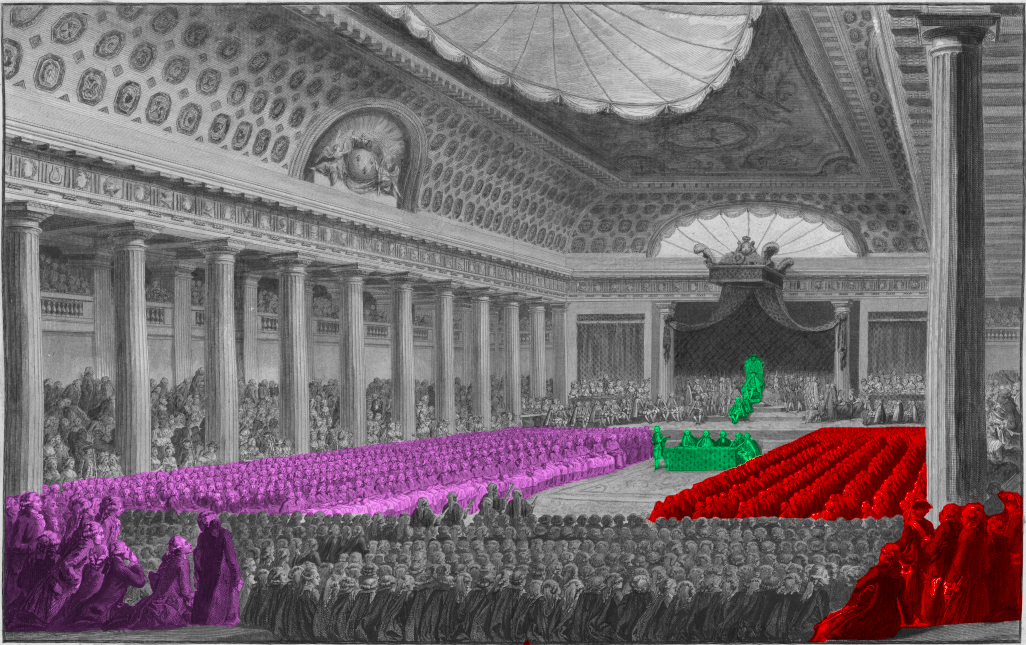
Since then, Western society has associated the political left with people, ideologies, and movements that seek a greater distribution of power, and the political right with those seeking a greater concentration of power.Hess, Karl. Dear America. 1975. "Power, concentrated in few hands, is the dominant historic characteristic of what most people, in most times, have considered the political and economic right wing. The far left, as far as you can get away from the right, would logically represent the opposite tendency and, in fact, has done just that throughout history. The left has been the side of politics and economics that opposes the concentration of power and wealth and, instead, advocates and works toward the distribution of power into the maximum number of hands."

Center
To this, we will add another term—the center. The center represents the current distribution of power. Because the political spectrum is a relative measure, the center of one society may differ significantly from that of another. A centrist, or moderate, is someone who promotes political positions that are near the center of their society, i.e., that don't significantly change the distribution of power.

The Four Parties
During the French Revolution, the left side was often referred to as liberals, as they wanted liberation from the clergy and nobility, especially the monarchy. The right side was seen as either conservative, because they wanted to preserve the three-estates system that maintained their privilege over the liberals and poor masses, or reactionary, because they wanted to reverse the "progress" of the left and return to a society ruled by political and spiritual dictators.
After the French Revolution, new ideologies and movements arose which sought to further challenge concentrations of power and were considered by contemporaries to be more left-wing than the liberals. These radicals promoted increased suffrage, republicanism, direct democracy, secularism, freedom of the press, and/or cooperative communities.
Thus, the political spectrum reflected four "parties," from left to right: radicals, liberals, conservatives (aristocrats), and reactionaries (absolutists).Rohmer, Friedrich. "Die Vier Parteien." Lehre von den politischen Parteien. 1844. "[I]t is not arbitrary to apply the same labels to parties in various European countries, regardless of their national labels. By this I mean the well-known words, 'radical,' 'liberal,' 'conservative,' (also 'aristocratic'), 'absolutistm' (or, 'reactionary'), and 'moderate,' terms which all European languages use to describe a general intellectual or aspirational tendency which transcends local peculiarities and local origins."

We also group these four parties to illustrate which are moderate, i.e. seeking minor and/or gradual change, and which are extreme, i.e., seeking radical transformation.

Ideologies
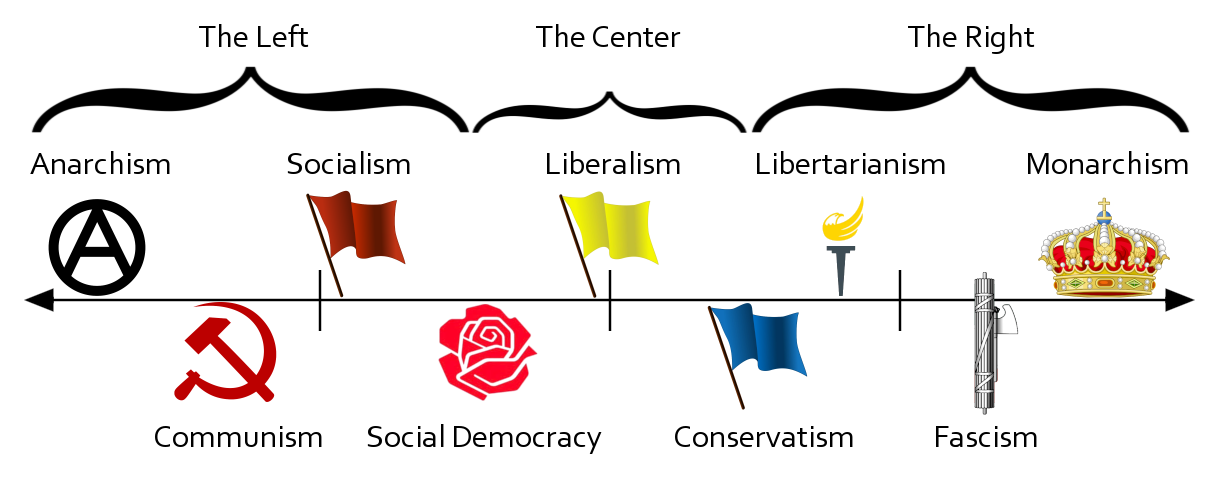
A more complete picture emerges when we arrange political ideologies on the spectrum:
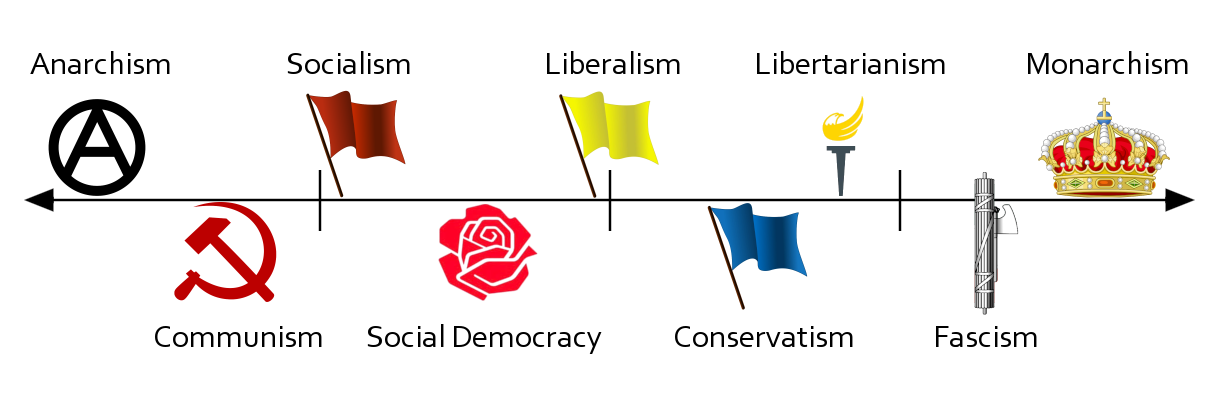
Because those of us in Western society have largely moved away from autocratic and/or theocratic governments to liberal democracies, liberalism is no longer viewed as left-wing, but centrist. Those who think our current republics function well and might just need a little reform include social democrats, greens, and progressives on the moderate left, classical liberals in the center, and conservatives and libertarians on the moderate right. The left begins at anticapitalism and includes some social democrats and the multitude of socialists, communists, and anarchists; whereas the right includes some conservatives and libertarians, as well as fascists, monarchists, and theocrats.